
The Listeners: A History of Wiretapping in the United States
Brian Hochman (2022)
 Wiretapping is nearly as old as electronic communications. Telegraph operators intercepted enemy messages during the Civil War. Law enforcement agencies were listening to private telephone calls as early as 1895. Communications firms have assisted government eavesdropping programs since the early twentieth century-and they have spied on their own customers too. Such breaches of privacy once provoked outrage, but today most Americans have resigned themselves to constant electronic monitoring. How did we get from there to here?
In The Listeners, Brian Hochman shows how the wiretap evolved from a specialised intelligence-gathering tool to a mundane fact of life. He explores the origins of wiretapping in military campaigns and criminal confidence games and tracks the use of telephone taps in the US government’s wars on alcohol, communism, terrorism, and crime. While high-profile eavesdropping scandals fuelled public debates about national security, crime control, and the rights and liberties of individuals, wiretapping became a routine surveillance tactic for private businesses and police agencies alike.
From wayward lovers to foreign spies, from private detectives to public officials, and from the silver screen to the Supreme Court, The Listeners traces the long and surprising history of wiretapping and electronic eavesdropping in the United States. Along the way, Brian Hochman considers how earlier generations of Americans confronted threats to privacy that now seem more urgent than ever.
 The challenges to humanity posed by the digital future, the first detailed examination of the unprecedented form of power called “surveillance capitalism,” and the quest by powerful corporations to predict and control our behaviour. Shoshana Zuboff provides startling insights into the phenomenon that she has named surveillance capitalism. The stakes could not be higher: a global architecture of behavior modification threatens human nature in the twenty-first century just as industrial capitalism disfigured the natural world in the twentieth. Zuboff vividly brings to life the consequences as surveillance capitalism advances from Silicon Valley into every economic sector. Vast wealth and power are accumulated in ominous new “behavioral futures markets,” where predictions about our behavior are bought and sold, and the production of goods and services is subordinated to a new “means of behavioral modification.”
 “Born in the mid-1990s up to the mid-2000s, iGen is the first generation to spend their entire adolescence in the age of the smartphone. With social media and texting replacing other activities, iGen spends less time with their friends in person-perhaps contributing to their unprecedented levels of anxiety, depression, and loneliness.
 Welcome to the age of behavioral addiction—an age in which half of the American population is addicted to at least one behavior. We obsess over our emails, Instagram likes, and Facebook feeds; we binge on TV episodes and YouTube videos; we work longer hours each year; and we spend an average of three hours each day using our smartphones. Half of us would rather suffer a broken bone than a broken phone, and Millennial kids spend so much time in front of screens that they struggle to interact with real, live humans.
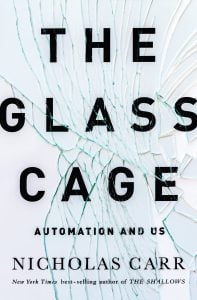 In The Glass Cage, Pulitzer Prize nominee and bestselling author Nicholas Carr shows how the most important decisions of our lives are now being made by machines and the radical effect this is having on our ability to learn and solve problems.
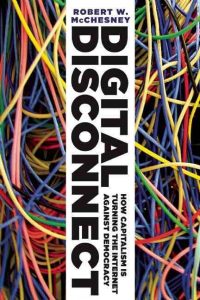 Celebrants and skeptics alike have produced valuable analyses of the Internet’s effect on us and our world, oscillating between utopian bliss and dystopian hell. But according to Robert W. McChesney, arguments on both sides fail to address the relationship between economic power and the Internet.
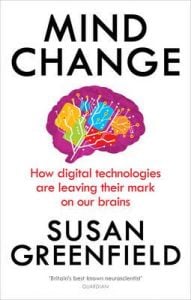 We live in a world unimaginable only decades ago: a domain of backlit screens, instant information, and vibrant experiences that can outcompete dreary reality. Our brave new technologies offer incredible opportunities for work and play. But at what price?
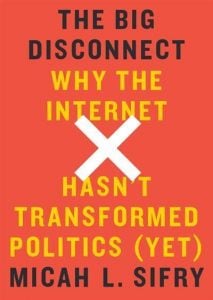 “Now that communication can be as quick as thought, why hasn’t our ability to organize politically—to establish gains and beyond that, to maintain them—kept pace? The web has given us both capacity and speed: but progressive change seems to be something perpetually in the air, rarely manifesting, even more rarely staying with us.
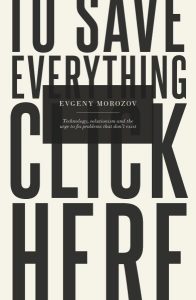 In the very near future, technological systems will allow us to make large-scale and sophisticated interventions into many more areas of public life: politics, culture, public debate, even our definitions of morality and human values. But how will these be affected once we delegate much of the responsibility for them to technology? The temptation of the digital age is to fix everything—from crime to corruption to pollution to obesity—by digitally quantifying, tracking, or gamifiying behavior. But when we change the motivations for our moral, ethical, and civic behavior, we may also change the very nature of that behavior itself. Technology, Evgeny Morozov proposes, can be a force for improvement—but only if we abandon the idea that it is necessarily revolutionary and instead genuinely interrogate what we are doing with it and what it is doing to us.
 This is the moment we’ve been waiting for, explains award-winning media theorist Douglas Rushkoff, but we don’t seem to have any time in which to live it. Instead we remain poised and frozen, overwhelmed by an always-on, live-streamed reality that our human bodies and minds can never truly inhabit. And our failure to do so has had wide-ranging effects on every aspect of our lives.
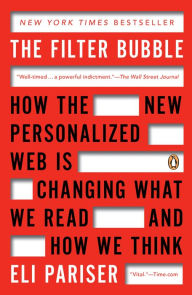 Imagine a world where all the news you see is defined by your salary, where you live, and who your friends are. Imagine a world where you never discover new ideas. And where you can’t have secrets.
 Technology has become the architect of our intimacies. Online, we fall prey to the illusion of companionship, gathering thousands of Twitter and Facebook friends, and confusing tweets and wall posts with authentic communication. But this relentless connection leads to a deep solitude. MIT professor Sherry Turkle argues that as technology ramps up, our emotional lives ramp down. Based on hundreds of interviews and with a new introduction taking us to the present day, Alone Together describes changing, unsettling relationships between friends, lovers, and families.
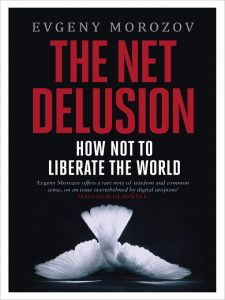 “The revolution will be Twittered!” declared journalist Andrew Sullivan after protests erupted in Iran. But as journalist and social commentator Evgeny Morozov argues in The Net Delusion, the Internet is a tool that both revolutionaries and authoritarian governments can use. For all of the talk in the West about the power of the Internet to democratise societies, regimes in Iran and China are as stable and repressive as ever. Social media sites have been used there to entrench dictators and threaten dissidents, making it harder—not easier—to promote democracy.
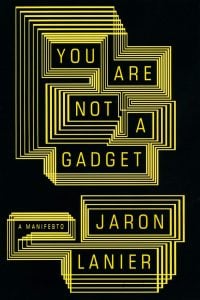 A programmer, musician, and father of virtual reality technology, Jaron Lanier was a pioneer in digital media, and among the first to predict the revolutionary changes it would bring to our commerce and culture. Now, with the Web influencing virtually every aspect of our lives, he offers this provocative critique of how digital design is shaping society, for better and for worse.
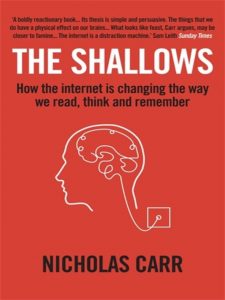 “Is Google making us stupid?” When Nicholas Carr posed that question, in a celebrated Atlantic Monthly cover story, he tapped into a well of anxiety about how the Internet is changing us. He also crystallized one of the most important debates of our time: As we enjoy the Net’s bounties, or are we sacrificing our ability to read and think deeply?
 For any parent who’s ever IM-ed their child to the dinner table – or yanked the modem from its socket in a show of primal parental rage – this account of one family’s self-imposed exile from the Information Age will leave you ROFLing with recognition. But it will also challenge you to take stock of your own family connections, to create a media ecology that encourages kids – and parents – to thrive.
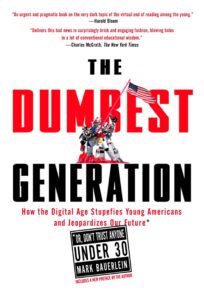 “For decades, concern has been brewing about the dumbed-down popular culture available to young people and the impact it has on their futures. But at the dawn of the digital age, many thought they saw an answer: the internet, email, blogs, and interactive and hyper-realistic video games promised to yield a generation of sharper, more aware, and intellectually sophisticated children. The terms “information superhighway” and “knowledge economy” entered the lexicon, and we assumed that teens would use their knowledge and understanding of technology to set themselves apart as the vanguards of this new digital era.
 James Bamford has been the preeminent expert on the National Security Agency since his reporting revealed the agency’s existence in the 1980s. Now Bamford describes the transformation of the NSA since 9/11, as the agency increasingly turns its high-tech ears on the American public.
 Whistleblower Mark Klein tells the story of the illegal government spying apparatus installed at an AT&T office by the National Security Agency, and his battle to bring it to light and protect Americans’ 4th Amendment rights. After the New York Times revealed in 2005 that the NSA was spying on Americans’ phone calls and e-mail without Constitutionally-required court warrants, the Bush administration openly defended this practice which also violated the Foreign Intelligence Surveillance Act. All details of the highly secret program remained hidden from the public—until Klein came forward. A technician for over 22 years at telecom giant AT&T, Klein was working in the Internet room in San Francisco in 2003 and discovered the NSA was vacuuming everyone’s communications into a secret room, and he had the documents to prove it (sample pages included). He went to the media in 2006, and then became a witness in a lawsuit brought against the company by the Electronic Frontier Foundation.
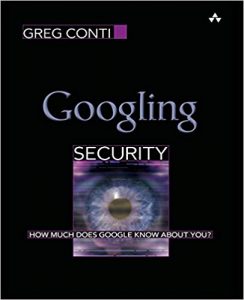 What Does Google Know about You? And Who Are They Telling? When you use Google’s “free” services, you pay, big time-with personal information about yourself. Google is making a fortune on what it knows about you…and you may be shocked by just how much Google does know. Googling Security is the first book to reveal how Google’s vast information stockpiles could be used against you or your business-and what you can do to protect yourself. Unlike other books on Google hacking, this book covers information you disclose when using all of Google’s top applications, not just what savvy users can retrieve via Google’s search results.