
ID: The Quest for Meaning in the 21st Century
Category: Books
Susan Greenfield (2008)
 If you’ve ever wondered what effect video games have on your children’s minds or worried about how much private information the government and big companies know about you, ID is essential reading.
Professor Susan Greenfield argues persuasively that our individuality is under the microscope as never before; now more then ever we urgently need to look at what we want for ourselves as individuals and for our future society.
ID is an exploration of what it means to be human in a world of rapid change, a passionately argued wake-up call and an inspiring challenge to embrace creativity and forge our own identities.
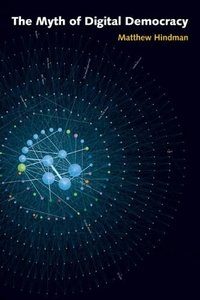 Is the Internet democratizing American politics? Do political Web sites and blogs mobilize inactive citizens and make the public sphere more inclusive? The Myth of Digital Democracy reveals that, contrary to popular belief, the Internet has done little to broaden political discourse but in fact empowers a small set of elites–some new, but most familiar.
 Endgame is a two-volume work by Derrick Jensen, published in 2006, which argues that civilization is inherently unsustainable and addresses the resulting question of what to do about it. Volume 1, The Problem of Civilization, spells out the need to immediately and systematically destroy civilization. Volume 2, Resistance, is about the challenging physical task that dismantling civilization presents.
 Whereas Volume 1 of Endgame presents the problem of civilization, Volume 2 of this pivotal work illustrates our means of resistance. Incensed and hopeful, impassioned and lucid, Endgame leapfrogs the environmental movement’s deadlock over our willingness to change our conduct, focusing instead on our ability to adapt to the impending ecological revolution.
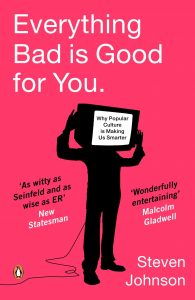 Forget everything you’ve ever read about the age of dumbed-down, instant-gratification culture. In this provocative, unfailingly intelligent, thoroughly researched, and surprisingly convincing big idea book, Steven Johnson draws from fields as diverse as neuroscience, economics, and media theory to argue that the pop culture we soak in every day—from Lord of the Rings to Grand Theft Auto to The Simpsons—has been growing more sophisticated with each passing year, and, far from rotting our brains, is actually posing new cognitive challenges that are actually making our minds measurably sharper. After reading Everything Bad is Good for You, you will never regard the glow of the video game or television screen the same way again.
 Unspeak is language as a weapon. Every day, we are bombarded with those apparently simple words or phrases that actually conceal darker meanings. ‘Climate change’ is less threatening than ‘global warming’; we say ‘ethnic cleansing’ when we mean mass murder. As we absorb and repeat Unspeak we are accepting the messages that politicians, businessmen and military agencies wish us to believe. Operation Iraqi Freedom did more than put a positive spin on the American war with Iraq; it gave the invasion such a likeable name that the American news networks quickly adopted it as their tagline for reporting on the war. By repackaging the language we use to describe international affairs or domestic politics, Unspeak tries to make controversial issues unspeakable and, therefore, unquestionable. In this thought-provoking and important book, Steven Poole traces the globalizing wave of modern Unspeak from culture wars to the culture of war and reveals how everyday words are changing the way we think.
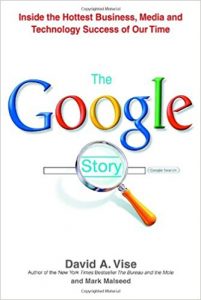 The Google Story is a definitive account of the populist media company powered by the world’s most advanced technology that in a few short years has revolutionized access to information about everything for everybody everywhere.
 Each time history repeats itself, the cost goes up. The twentieth century—a time of unprecedented progress—has produced a tremendous strain on the very elements that comprise life itself: This raises the key question of the twenty-first century: How much longer can this go on? With wit and erudition, Ronald Wright lays out a-convincing case that history has always provided an answer, whether we care to notice or not. From Neanderthal man to the Sumerians to the Roman Empire, A Short History of Progress dissects the cyclical nature of humanity’s development and demise, the 10,000-year old experiment that we’ve unleashed but have yet to control. It is Wright’s contention that only by understanding and ultimately breaking from the patterns of progress and disaster that humanity has repeated around the world since the Stone Age can we avoid the onset of a new Dark Age. Wright illustrates how various cultures throughout history have literally manufactured their own end by producing an overabundance of innovation and stripping bare the very elements that allowed them to initially advance. Wright’s book is brilliant; a fascinating rumination on the hubris at the heart of human development and the pitfalls we still may have time to avoid.
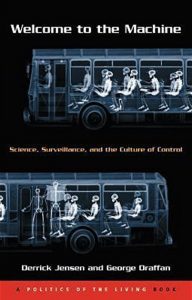 In the face of RFID chips, consumer tracking strategies, and illegal government wiretapping, Jensen and Draffan are determined to show consumers how to fight back against government and industry to regain their rights, their privacy, and their humanity. The book takes a hart-hitting look at the way technology is used as a machine, to control us and our environment.
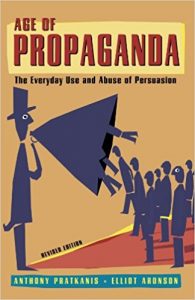 Americans create 57% of the world’s advertising while representing only 6% of its population; half of our waking hours are spent immersed in the mass media. Persuasion has always been integral to the democratic process, but increasingly, thoughtful discussion is being replaced with simplistic soundbites and manipulative messages.
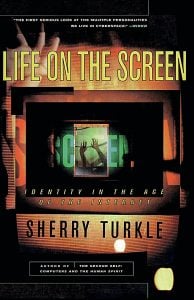 Life on the Screen is a book not about computers, but about people and how computers are causing us to reevaluate our identities in the age of the Internet. We are using life on the screen to engage in new ways of thinking about evolution, relationships, politics, sex, and the self. Life on the Screen traces a set of boundary negotiations, telling the story of the changing impact of the computer on our psychological lives and our evolving ideas about minds, bodies, and machines. What is emerging, Turkle says, is a new sense of identity- as decentered and multiple. She describes trends in computer design, in artificial intelligence, and in people’s experiences of virtual environments that confirm a dramatic shift in our notions of self, other, machine, and world. The computer emerges as an object that brings postmodernism down to earth.
 Simulacra and Simulation (French: Simulacres et Simulation) is a 1981 philosophical treatise by Jean Baudrillard, in which he seeks to examine the relationships among reality, symbols, and society, in particular the significations and symbolism of culture and media that are involved in constructing an understanding of shared existence.
 In his critically acclaimed Four Arguments for the Elimination of Television, author and social critic Jerry Mander proclaimed that television, by its fundamental nature, is dangerous—to personal health and sanity, to the environment, and to the democratic process. With In the Absence of the Sacred, he goes beyond television to critique our technological society as a whole.
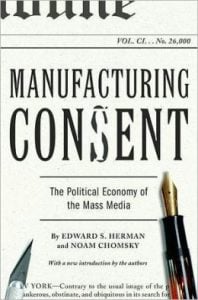 We normally think that the press are cantankerous, obstinate, and ubiquitous in its search for truth. In Manufacturing Consent Edward Herman and Noam Chomsky show how an underlying elite consensus largely structures all facets of the news. Far from challenging established power, the media work hard to discover and mirror its assumptions. The authors skilfully dissect the way in which the marketplace and the economics of publishing significantly shape the news. They reveal how issues are framed and topics chosen, and contrast the double standards underlying accounts of free elections, a free press, and governmental repression. The authors conclude that the modern mass media can best be understood in terms of a ‘propaganda model’. News and entertainment companies dedicate themselves to profit within the established system. Their interests require that they support the governing assumptions of state and private power. The propaganda model provokes outrage from journalists, editors and broadcasters, but twenty years after first publication, Manufacturing Consent remains the most important critique of the mass media.
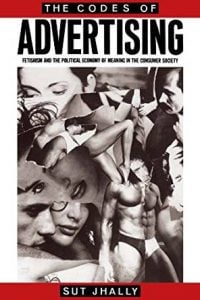 This book examines the commercial speech of advertising as a cultural phenomenon whose social significance far exceeds its economic influence. Jhally argues that by selling viewing time to advertisers, television converts audiences into laborers who “work” for the media in the same way that workers do in a factory. By watching commercial messages on TV, viewers actively create symbolic meaning, but also generate profit for the media in return for the wage of entertainment.
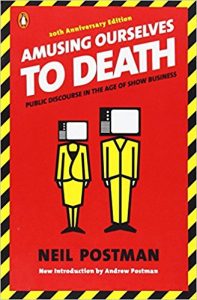 Postman distinguishes the Orwellian vision of the future, in which totalitarian governments seize individual rights, from that offered by Aldous Huxley in Brave New World, where people medicate themselves into bliss, thereby voluntarily sacrificing their rights. Drawing an analogy with the latter scenario, Postman sees television’s entertainment value as a present-day “soma”, the fictitious pleasure drug in Brave New World, by means of which the citizens’ rights are exchanged for consumers’ entertainment.
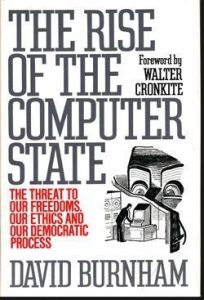 An award-winning reporter documents case after case of the computer’s threat to our privacy, legal procedures, and the democratic process, providing clear evidence of the present and probable dangers of computer technology.
 A total departure from previous writing about television, this book is the first ever to advocate that the medium is not reformable. Its problems are inherent in the technology itself and are so dangerous — to personal health and sanity, to the environment, and to democratic processes — that TV ought to be eliminated forever.
 The Myth of the Machine is a two-volume book taking an in-depth look at the forces that have shaped modern technology since prehistoric times. The first volume, Technics and Human Development, was published in 1967, followed by the second volume, The Pentagon of Power, in 1970. The author, Lewis Mumford, shows the parallel developments between human tools and social organization mainly through language and rituals. It is considered a synthesis of many theories Mumford developed throughout his prolific writing career. Volume 2 was a Book-of-the-Month Club selection.
 “In The Myth of the Machine, Mumford insisted upon the reality of the megamachine: the convergence of science, economy, technics and political power as a unified community of interpretation rendering useless and eccentric life-enhancing values. Subversion of this authoritarian kingdom begins with that area of human contact with the world that cannot be successfully repressed – one’s feelings about one’s self.”
 The Society of the Spectacle (French: La société du spectacle) is a 1967 work of philosophy and Marxist critical theory by Guy Debord, in which the author develops and presents the concept of the Spectacle.